 Listicle
Is Your Florida Business Tax Compliance Checklist Complete?
Quick Summary
A complete Florida business tax compliance checklist confirms your entity is active on Sunbiz, registers for a sales and use tax account for each location that sells taxable items, and secures any local business tax receipt, such as the Coral Springs receipt. It also maps every filing deadline on one calendar and keeps organized records that support your sales tax, expenses and payroll.
- Check that your entity is active on Sunbiz with a current annual report.
- Verify a sales and use tax account is open for each location that sells taxable items.
- A local business tax receipt is separate from state registration and is issued by the city.
- Many counties add a discretionary surtax, so confirm the rate for each county you sell into.
- Use one calendar listing every obligation, due date, responsible person and filing method.
Table of Contents
- Step 1: Confirm Your Florida Business Tax Registration
- Step 2: Get Your Coral Springs Business Tax Receipt
- Step 3: Meet Florida Sales Tax Filing Requirements
- Step 4: Map Your Florida Small Business Tax Deadlines
- Step 5: Keep the Right Tax Records for Florida
- Step 6: Choose the Right Tools and Help for Each Task
- Booking a Compliance Review with Numeric Experts
- Frequently Asked Questions
Step 1: Confirm Your Florida Business Tax Registration
Last Updated: October 29, 2026
Florida business tax compliance starts with registration, and most missed deadlines trace back to a gap here. Use this florida business tax compliance checklist to confirm you are registered before you collect a single dollar of sales tax.
Start by checking your entity status with the Florida Department of State. The Sunbiz portal shows whether your LLC or corporation is active and whether its annual report is current. An inactive entity can lose its liability protection and creates problems with banks and tax filings.
Next, confirm your state tax registrations. Businesses that sell taxable goods or services in Florida generally need a sales and use tax account with the Florida Department of Revenue (Florida Dept. of Revenue). Many owners assume the entity filing covers everything. It does not.
Here is a quick checklist to review:
- Entity is active on Sunbiz with a current annual report
- Registered agent is correct and reachable
- Sales and use tax account is open for each location that sells taxable items
- Federal EIN matches the name on every state account
- Owner contact details are current with the state
A common mistake is registering only the business name and forgetting the location-level requirement. Verify each location separately with the Florida Department of Revenue.
Step 2: Get Your Coral Springs Business Tax Receipt
If you operate in Coral Springs, a local business tax receipt is a separate requirement from state registration. The city issues it, and it is usually tied to your business activity and location. Operating without one can lead to fines, so treat it as a fixed item on your florida business tax compliance checklist.
Apply through the City of Coral Springs before you open or when your address changes. Bring your entity documents and a clear description of what your business does, since the receipt category depends on it. Renewals follow the city's annual schedule, so set a reminder well before the due date.
Keep the receipt where you can produce it quickly. Banks, landlords, and inspectors often ask for it, and a missing receipt delays more than the tax itself.
Step 3: Meet Florida Sales Tax Filing Requirements
Florida has a state sales tax, and many counties add a discretionary surtax on top (Florida Dept. of Revenue). Check the current published rates for each county. That means your effective rate depends on where the sale is made, not just where your office sits. Confirm the rate for each county you sell into before you set up point-of-sale software.
Filing frequency depends on how much tax you collect, and the Department of Revenue assigns the schedule. Filing late or underpaying can trigger penalties and interest even when you did not intend to owe less.
Build a simple process:
- Record taxable sales separately from exempt sales.
- Note the county for every transaction.
- Reconcile collected tax against your sales records each period.
- File and pay on the assigned due date.
Watch out: software set to a single flat rate will undercollect in counties with surtaxes, and the shortfall comes out of your pocket at audit.
Step 4: Map Your Florida Small Business Tax Deadlines
Deadlines are where most small businesses fall behind. Florida businesses can owe state sales tax returns, federal payroll deposits, federal income tax filings, annual reports, and local receipt renewals, each on a different schedule.
Build one calendar that lists every obligation with its due date, the responsible person, and the filing method. Recurring items like annual reports and sales tax returns belong on the calendar the moment they are assigned. Federal deadlines can move when they fall on weekends or holidays, so check the official IRS and Florida calendars each year rather than relying on memory.
Many owners find that one missed deadline causes a chain of others. Treat the calendar as the backbone of your florida business tax compliance checklist, and review it at the start of each quarter.
The article lists several obligations that each run on a different schedule, so it helps to see them side by side.
| Obligation | Who issues or sets it | Timing |
|---|---|---|
| State sales and use tax return | Florida Department of Revenue | Schedule assigned by the Department |
| Federal payroll deposits | Federal government | Set by federal rules |
| Federal income tax filing | IRS | Annual, check official calendar each year |
| Annual report | Florida Department of State (Sunbiz) | Annual |
| Local business tax receipt renewal | City of Coral Springs | Annual schedule |
Step 5: Keep the Right Tax Records for Florida
Good records make every other step easier. Florida and federal rules both expect you to keep documentation that supports the sales tax you collected, the expenses you deducted, and the payroll you reported. Keep the retention period required by the Florida Department of Revenue in mind when you choose storage.
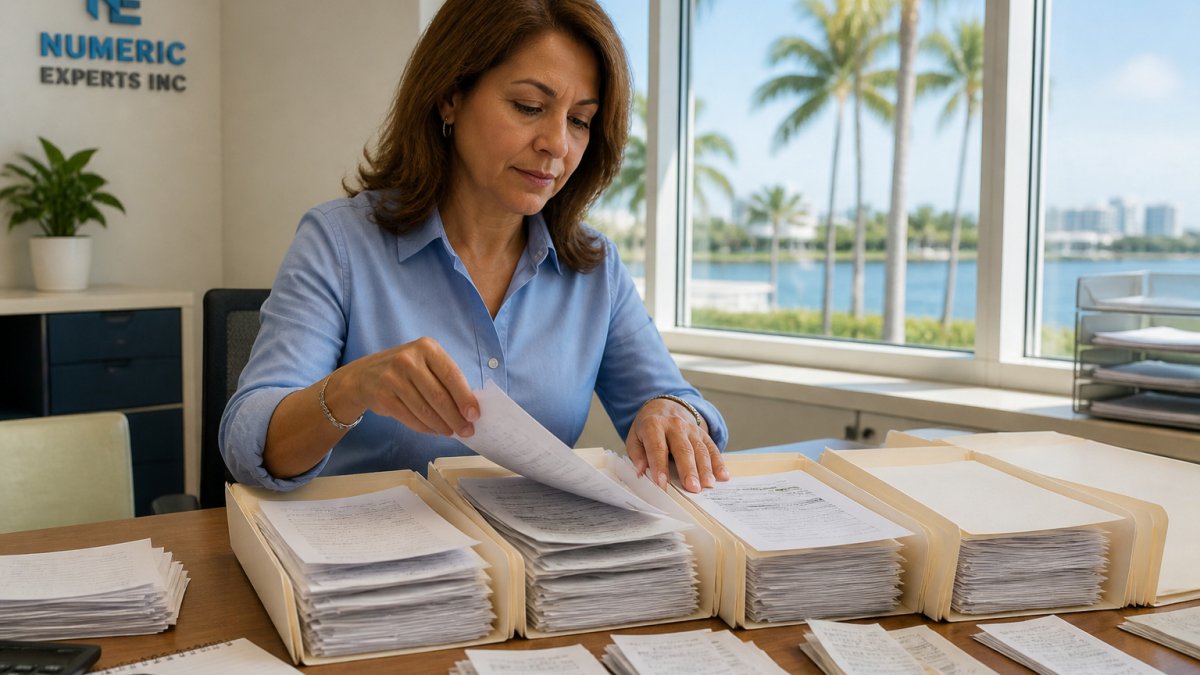
Organize records by month and by tax type. Keep sales reports, exemption certificates, invoices, bank statements, and payroll reports together. Store digital copies in a secure, backed-up location, and label each file with the period it covers.
Numeric Experts explains a practical receipt system in more detail. Setting it up once saves hours during audits and tax season.
Step 6: Choose the Right Tools and Help for Each Task
No single tool handles every Florida requirement. Match the tool to the task:
- Entity and annual reports: the Sunbiz portal, which is the official state source.
- Sales tax calculation and filing: tax automation software can handle county surtaxes if your sales volume justifies the cost.
- Ongoing bookkeeping: Numeric Experts can run bookkeeping for owners who want the records kept current without doing it in-house.
- Complex questions or audits: a tax professional who knows Florida rules, found through how to find reliable tax accountants.
Ask for a quote and what each option includes, especially whether filing and audit support are part of the fee.
Booking a Compliance Review with Numeric Experts
If you are unsure whether your florida business tax compliance checklist is complete, a review can show gaps before a deadline or audit does. Explore the full range of tax, bookkeeping, and accounting services offered for individuals and businesses in FL and CA. Numeric Experts is a full-service accounting firm offering personal and business tax, bookkeeping, and consulting services, with expert advocacy for complex IRS matters including audits, liens, and levies.
To schedule a review, contact Numeric Experts. Pricing depends on the scope of work, so the team will confirm the cost during your consultation rather than quoting a flat figure here.
Frequently Asked Questions
What taxes does a small business have to pay in Florida?
Florida businesses may owe several taxes depending on their activity. The most common is the state sales and use tax, which many counties supplement with local discretionary surtaxes. Businesses with employees also handle payroll-related taxes at the federal level, and businesses that sell goods or services must register before collecting tax. The Florida Department of Revenue publishes current rates and registration rules, and checking those sources before you open or expand is the safest starting point.
Does a Florida business need a local business tax receipt?
Most businesses operating in Florida need a local business tax receipt issued by the county or municipality where they operate, in addition to any state registration. Coral Springs businesses should confirm the city requirement with the city's business tax office before opening, because receipt fees and renewal dates depend on the local jurisdiction and business type. Operating without a current receipt can lead to penalties, so add the renewal date to your compliance calendar.
When are Florida sales tax returns due?
Florida sales tax returns are due on the schedule the Department of Revenue assigns when you register. Filing frequency depends on the amount of tax your business collects, and the Florida Department of Revenue assigns the schedule when you register. Late filing can trigger penalties and interest, so confirm your assigned filing frequency in your account and set reminders ahead of each due date.
What tax records should a Florida small business keep?
Keep sales records, purchase invoices, bank statements, payroll records, and copies of every return and receipt you file. Store records in a way that lets you reproduce figures for any reporting period, since audits often request documentation for several years back. Retain copies of your state registration, local business tax receipt, and sales tax certificate alongside your financial records so you can prove compliance quickly.